
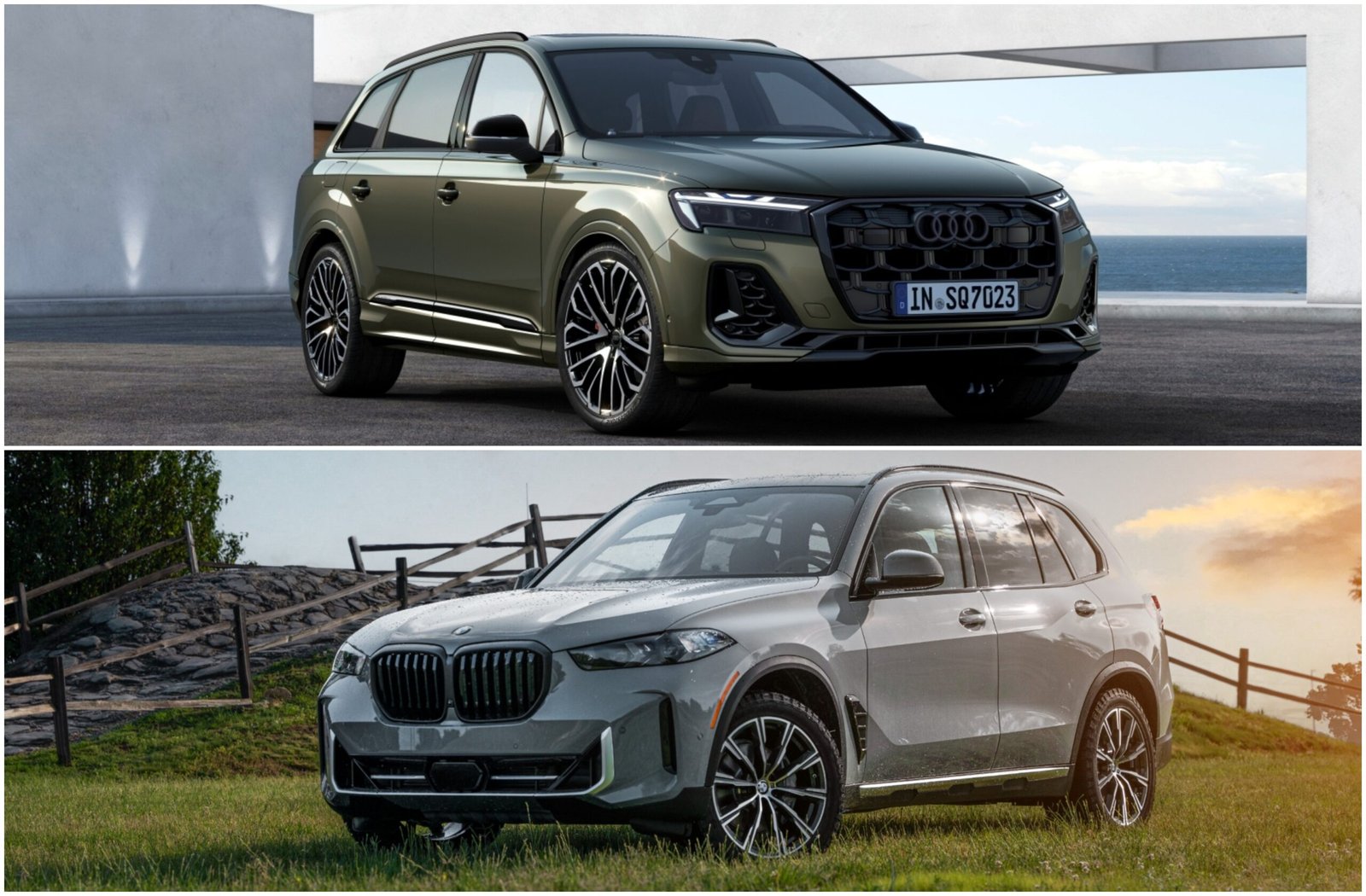
The BMW X5 and the Audi Q7 are long-standing rivals in the luxury SUV segment. As of 2025, both have matured significantly, offering refined engineering, potent powertrains, and a suite of modern technology. Yet, they continue to cater to different buyer priorities: the X5 leans more toward sporty driving dynamics, while the Q7 emphasizes versatility and practicality (especially for families).
This comparison dives deep into what each SUV brings to the table for 2025 and helps you decide which better suits your lifestyle and driving needs.
1. Performance and Powertrains
BMW X5 (2025)
Engine Options
- The 2025 X5 continues to offer a range of engine choices, including a 3.0-liter inline-six (turbocharged) and a plug-in hybrid variant.
- According to BMW’s technical data, the PHEV (xDrive50e) system combines a gas engine and electric motor to deliver about 489 horsepower and 670 Nm of torque.
- For diesel markets, BMW also offers a 3.0-liter twin-power diesel engine in some regions.
Acceleration and Driving Dynamics
- The X5 is known for its more sporty driving character. Reviewers note its tight handling, minimal body roll, and responsive chassis.
- According to a comparison by Ciocca BMW, some trims hit 0–60 mph in as little as 3.7 seconds (for high-performance variants).
- Its all-wheel-drive system (xDrive) and optional adaptive suspension enhance both performance and ride comfort.
Fuel Economy
- Fuel consumption depends heavily on the variant, but the PHEV offers a significant electric-only range. According to BMW, the WLTP range for the electric part is around 94–100 km.
- For the non-hybrid versions, combined fuel economy still remains competitive in the luxury SUV class.
Audi Q7 (2025)
Engine Options
- The primary engine for the 2025 Q7 is a 3.0-liter turbocharged V6, producing 335 hp and 369 lb-ft of torque.
- It uses an 8-speed automatic transmission and standard quattro all-wheel drive.
- Audi also incorporates a 48V mild-hybrid system to boost efficiency.
Acceleration
- According to Audi’s press materials, the Q7 55 TFSI (V6) can accelerate from 0–62 mph (0–100 km/h) in about 5.6 seconds.
- Car & Driver’s real-world test pegged it at 5.9 seconds to 60 mph, which is respectable for a three-row SUV.
Fuel Efficiency
- EPA ratings for the Q7 are approximately 20 mpg combined, with 18 mpg city and 23 mpg highway for the V6 model.
- European figures (or for markets using liters/100 km) from Audi suggest combined consumption around 10.1–11.0 L/100 km for some versions.
Towing & Utility
- The V6 models have a towing capacity of up to about 7,700 lbs, which is quite strong for this class.
- All Q7s have quattro AWD, giving them solid traction and stability, especially under load or in less-than-ideal road conditions.
2. Dimensions & Practicality
BMW X5
- According to BMW’s own specs, the 2025 X5 has a length of 4,935 mm and a width of 2,004 mm (including certain trim variations).
- Cargo capacity: The X5 offers 650 liters with the rear seats up, expanding substantially when they are folded down.
- The X5 is typically a five-seater, though some markets may have optional third-row packages (depending on region).
Practical Observations
- The X5’s layout and design prioritize a driver‑focused experience; it is less about maximal cargo space and more about driving engagement.
- Its second-row seats split in a 40/20/40 format (in some trims), which aids flexibility for passengers and cargo.
Audi Q7
- According to official data: wheelbase of 117.9 in, overall length of 199.6 in, width of 77.5 in, and height of about 68.5 in.
- Seating: The Q7 is a seven-seater with three rows, which gives it a strong advantage in passenger capacity.
- Cargo volume:
- Behind the first row: ~69 ft³ (≈ 70 cu ft)
- Behind the second row: ~36 ft³ (≈ 35–36 cu ft)
- Behind the third row: ~14 ft³ (≈ 13.6–14 cu ft)
Utility Observations
- The Q7’s third row is usable, though the headroom and legroom are tighter compared to the first two rows (headroom for third row ~35.9 in, legroom ~29.2 in).
- With all rows folded, particularly the second and third, the Q7 provides impressive cargo space, reinforcing its family‑SUV credentials.
- Optional air suspension and high towing capacity make it a versatile choice for family trips or towing needs.
3. Interior, Comfort & Luxury
BMW X5
- The X5’s interior is driver-centric, following BMW’s philosophy of performance with luxury.
- Materials are high-quality: leather seating, soft-touch surfaces, and premium finishes feel well‑constructed.
- Infotainment: BMW’s iDrive system (depending on trim) is highly refined; controls are precise, and the display is sharp.
- Though not always offering a third row in all markets, the second row is spacious and well-padded for comfort.
Comfort & Ride Feel
- The X5 can be tuned with adaptive or sport suspension to favor either a stiffer, performance feel or a more cushioned ride.
- Tire sizes vary by trim, and larger wheels (such as M Sport variants) can make ride stiffer – something to consider if comfort is a priority.
- It maintains good composure over bumps while preserving sporty driving responses
Audi Q7
- Across all three rows, the Q7 places a premium on comfort and practicality. The interior is sumptuous, with optional leather (Valcona), ambient lighting, and premium finishes.
- Technology highlights:
- Audi Virtual Cockpit: a fully digital instrument cluster, customizable, sharp graphics.
- Infotainment screen: the Q7 includes a large center touchscreen; some versions offer the Audi connect system, with features like NAV PLUS and app integration.
- Comfort features: four‑zone climate control, massaging seats, and a panoramic sunroof are available depending on trim.
Ride Quality
- The Q7 rides smoothly, especially with the optional adaptive air suspension, which helps absorb road imperfections.
- While it’s not as sporty as the X5, its ride is notably composed for a large three-row SUV. Autocar India noted that the Q7 “feels large and wallowy,” favoring comfort above sharp handling.
4. Safety & Driver Assistance
BMW X5
- BMW typically loads its X5 with advanced driver-assistance features, though specific 2025 data may vary by region.
- From dealer sources, expected safety gear includes adaptive cruise control, blind-spot monitoring, lane-keeping assistance, and collision mitigation systems.
- Reliability: According to Ciocca BMW, the 2025 X5 earns a reliability score of 78/100 from J.D. Power.
- Resale value: The X5 tends to hold value well, with iSeeCars reporting a 5-year depreciation of ~56.1%, which is modest for a luxury SUV.
Audi Q7
- The Q7 is also highly rated for safety: IIHS side crash tests for 2025 (based on earlier model tests) rated it Good (G) in structure, head/neck, torso, and pelvis.
- Driver-assistance: Standard features typically include adaptive cruise control, Audi pre-sense (collision prevention), automatic emergency braking, and lane‑keeping aids.
- Ownership concerns: Some real-world users report issues with software, electrical systems, and “drive system” warnings.
- Warranty: According to MotorDonkey, the Q7 comes with a 4-year / 50,000-mile comprehensive warranty.
5. Technology & Infotainment
BMW X5
- The X5 offers BMW’s latest iDrive system, which is well-known for its intuitive interface, responsive touch, and crisp graphics.
- Digital instrument cluster options are available, often complemented by a head-up display in higher trims.
- Connectivity: Apple CarPlay and Android Auto typically come standard, and newer models may support wireless connectivity depending on the market.
Audi Q7
- The Q7 features Audi’s Virtual Cockpit, a fully digital gauge cluster with high customization and very clear graphics.
- Infotainment: Large touchscreen (10.1″ in some versions) for MMI, plus Audi connect capabilities.
- Phone integration: Wireless Apple CarPlay and Android Auto are standard
- Premium audio: Optional Bang & Olufsen 3D sound system for an immersive experience.
- Additional tech: Head-up display, 360° camera system, and optional advanced driver-assist packages.
6. Ownership Costs, Reliability & Resale
BMW X5
- Maintenance: As with most performance‑oriented luxury vehicles, maintenance and repair costs can be higher than non-luxury brands, especially for performance or hybrid variants.
- Resale: According to iSeeCars, the X5 retains value better than many competitors, with a 5-year depreciation rate that is lower than the Q7.
- Reliability: Generally rated solidly, though long-term costs (especially for hybrid versions) can be significant due to battery and related system maintenance.
Audi Q7
- Maintenance and repairs for Audi tend to be relatively expensive, especially for complex systems like the mild-hybrid drivetrain.
- Depreciation: According to iSeeCars, the Q7 loses about 60.9% of value over five years — slightly more than the X5 in comparable analyses.
- Reliability: There are some owner-reported issues such as electrical glitches and software bugs.
- Warranty: 4 years / 50,000 miles as mentioned above.
7. Which One Is Right for You?
Choosing between the 2025 BMW X5 and Audi Q7 ultimately depends on what you prioritize in a luxury SUV. Here are some key scenarios to help guide your decision:
- Choose the BMW X5 if:
- You want sportier driving dynamics, sharper handling, and a more performance-oriented feel.
- You prefer a luxury SUV that feels more like a driver’s car than just a utility vehicle.
- You don’t necessarily need three rows of seats, or prioritize cargo over passenger capacity.
- You favor a plug-in hybrid variant for occasional electric driving.
- Choose the Audi Q7 if:
- Family needs are high: you need a third row, more seats, or more flexible passenger capacity.
- Cargo space matters, especially when folding down seats.
- Comfort, ride smoothness, and long-distance usability are more important to you than outright sportiness.
- You want strong tow capacity and more utility in a daily, luxury family crossover.
Strengths & Trade-Offs — Side-by-Side
| Feature | BMW X5 | Audi Q7 |
|---|---|---|
| Driving Dynamics | Sporty, agile, performance‑oriented | Comfort-first, smooth ride, less sporty |
| Seating Capacity | Typically 5 seats | 7 seats (3 rows) |
| Cargo Flexibility | Good, but limited by fewer rows | Very flexible with fold-down rows |
| Powertrain Variety | Gasoline, hybrid (PHEV) | Gasoline with mild-hybrid, possibly more options depending on market |
| Fuel Efficiency | Efficient PHEV, good gas consumption | Mild-hybrid helps, but V6 is less efficient vs smaller engines |
| Towing Capacity | Strong (varies by trim) | Up to ~7,700 lb (depending on engine) |
| Infotainment & Tech | iDrive, digital cluster, driver-focused | Virtual Cockpit, touchscreen, premium audio, app integration |
| Safety | Comprehensive ADAS, strong reliability | Good crash ratings, lots of driver-assist, but some owner-reported software issues |
| Resale / Depreciation | Better resale value per iSeeCars iSeeCars | Slightly higher depreciation per iSeeCars |